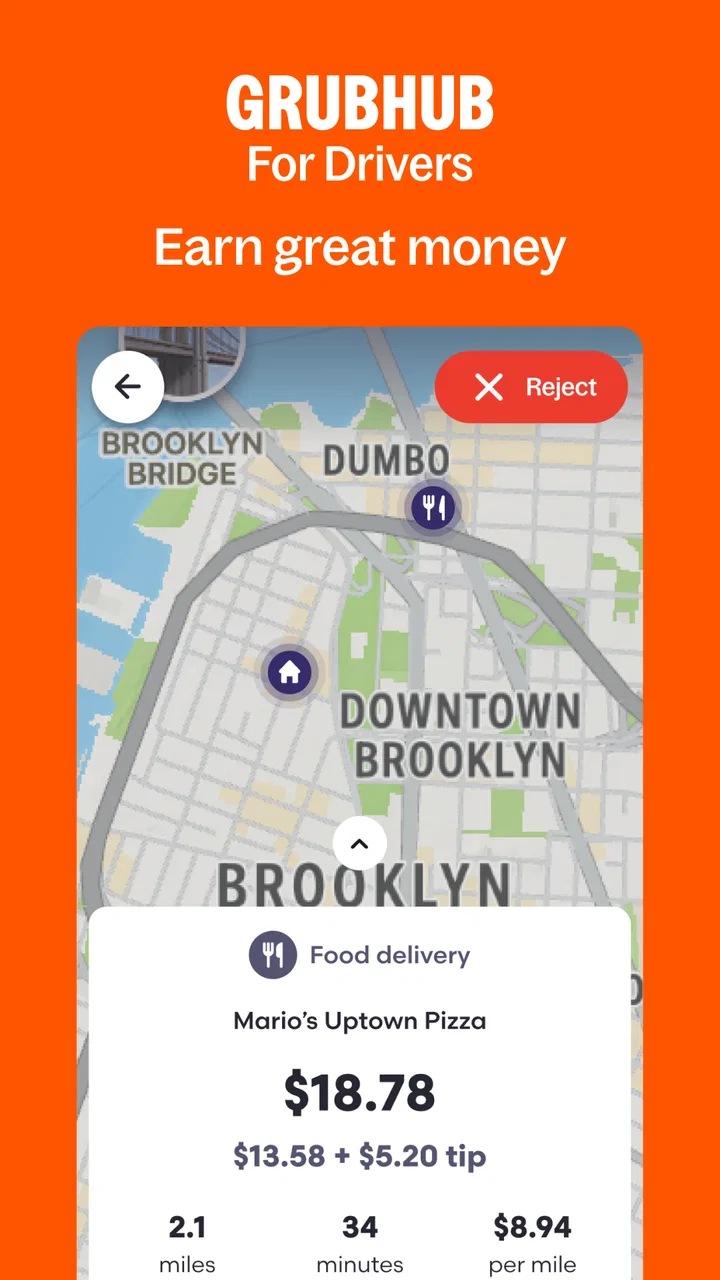
Grubhub for Drivers
- 4.5
- Rating
- 1.00M
- Installs
- Free
- Price

 Analysis by App-foxy
Driving for a delivery platform is not only about accepting an order and reaching a restaurant. The app has to remain understandable when I am checking it between stops, usable when my hands are busy, and practical when traffic, weather, or a changing schedule gets in the way. Grubhub for Drivers is Grubhub’s business app for people who want to drive and earn extra money, and I found its value depends less on flashy extras than on how comfortably it fits into a real delivery routine.
The app is free, aimed at everyone from a content-rating perspective, and developed by Grubhub. It has built a substantial audience, with more than a million installs and an average rating of 4.6 from roughly 77 thousand ratings. Those figures suggest that many drivers find the basic workflow dependable, although a popular app is not automatically the right fit for every person or every working situation.
How Grubhub for Drivers feels during a normal shift
My first impression is that this is a focused tool rather than a general-purpose business suite. Its job is to help a driver manage delivery work, not to replace a full accounting app, navigation service, or personal schedule. That narrow purpose is useful because I can think in terms of the next practical decision: whether to work, whether to take an offer, where to go, and what needs attention before moving again.
You May Also Like

 Blood Strike: 2.5 Anniversary
Blood Strike’s Loadouts Turn Every Drop Into a Tactical Gamble
A close look at Blood Strike’s custom loadouts: how fast access to signature weapons reshapes its battle royale rhythm, rewards preparation, and narrows the gap between fights.

 Pandora - Music & Podcasts
Pandora’s Music Is Easy to Start, but Harder to Recover
Pandora’s strength is its low-effort path from a seed to a station. Its weak spot is how much confidence it asks you to place in connection, setup, and quiet recovery.

 8 Ball Pool
 Is Built on Rivalries, Rematches, and Routine
A close look at the rivalries, rematches, shared routines, and unanswered safety questions that turn a quick pool match into a persistent mobile community.

 Samsung Music
’s Quiet Strength Is Playing What You Already Own
Its reach comes less from spectacle than from dependable access to a personal library. That simplicity is both the app’s strongest retention engine and its ceiling.

 AccuWeather: Weather Radar
AccuWeather Review: A Quick, Clear Forecast for Everyday Decisions
For everyday plans, the best forecast is the one you can understand quickly. AccuWeather makes rain timing, radar, and local conditions easy to act on, with a few trade-offs.

 Hill Climb Racing
Why Hill Climb Racing Still Turns Crashes Into One More Run
A tiny car, a bumpy hill and one more upgrade: Hill Climb Racing keeps resurfacing because its simple chaos makes every near-miss feel personal.
More From Our News Desk



A realistic use case is a driver who has a spare evening after work. Instead of committing to a fixed shift elsewhere, that person can open the app, review the available delivery workflow, and decide whether the opportunity suits the time and energy available. This flexibility is one of the strongest reasons to consider it. It is especially appealing for someone who already has a vehicle and wants an additional income option rather than a complete replacement for a regular job.
That flexibility also creates a responsibility. The app can organize delivery activity, but it cannot make an unpredictable road, restaurant delay, or busy period disappear. I would treat it as a tool for coordinating work, not as a promise of effortless earnings. Anyone considering it should be comfortable making decisions on the road, handling waiting time, and keeping personal records outside the app when needed.
Readable information when attention is divided
Readability matters more here than it would in a casual shopping app. A driver may be standing outside a restaurant, looking at a phone in bright daylight, or checking details while wearing gloves in cold weather. In my experience, a useful delivery interface is one where the next action is easy to identify without reading a long explanation. Grubhub for Drivers is strongest when I use it in short checks rather than trying to study everything while moving between locations.
I recommend setting up the app before starting a delivery period. Review the account and work-related details while stationary, then keep the phone positioned where it can be checked safely. This simple habit reduces the temptation to explore screens during a stop. It also helps separate preparation from active driving, which is important for both usability and safety.
The app’s business focus gives its screens a clearer purpose than a broad restaurant-ordering app would have. A customer-facing food app is designed around browsing meals, comparing restaurants, and placing an order. The driver version has a different priority: it supports the person completing the delivery. That distinction makes it more appropriate for drivers, while someone who only wants to order food will find the usual Grubhub customer app more suitable.
For people who prefer larger text, stronger contrast, or a particular screen reader setup, the practical experience may depend on the phone’s operating-system settings and how individual screens respond to them. I would test those settings before relying on the app for a full shift. It is better to confirm that essential information is comfortable to read and that controls are easy to locate than to discover a problem after accepting work.
Navigation is part of the whole experience
Delivery work involves more than the driver app itself. I also need a dependable mapping tool, a clear phone mount, and a way to hear or review directions without repeatedly touching the screen. Grubhub for Drivers should be viewed as one part of that setup. The app can support the delivery workflow, but the quality of the trip still depends on the phone, vehicle, road conditions, and the navigation method I choose.
One useful trade-off is keeping the driver app and navigation app in clearly defined roles. I use the delivery app for delivery decisions and status-related tasks, then rely on navigation for the route. Switching constantly between unrelated screens can increase confusion, especially when a restaurant address is difficult to find or a customer location has several entrances. Before leaving a pickup point, I would confirm the destination and route while parked, rather than trying to resolve every detail at the curb.
This approach also helps drivers with attention-related or visual challenges. Fewer rapid transitions mean less mental effort. A short routine—check the destination, confirm the route, secure the phone, then drive—can be easier to repeat than improvising every time. The app does not remove the need for that routine, but its focused purpose makes it possible to build one around delivery tasks.
Motor and sensory considerations on the road
People use delivery apps in very different physical conditions. Some may have limited hand movement, reduced grip, tremors, fatigue, or difficulty making precise taps. Others may be sensitive to glare, sound, vibration, or crowded visual layouts. I would not assume that a workflow comfortable for one driver will be equally comfortable for another.
A practical adjustment is to avoid using the phone while holding food, keys, or a vehicle door. I would finish one physical task, place the items securely, and then interact with the app. A stable mount and voice guidance from the navigation tool can reduce repeated reaching. These are not special tricks limited to one type of driver; they make the experience safer and less tiring for nearly everyone.
Drivers who find small touch targets difficult should spend time testing the essential controls while parked. If a button requires repeated taps or if a screen changes unexpectedly, that is a meaningful barrier, not a minor annoyance. A larger system font may improve reading without necessarily making every control easier to press, so I would evaluate both text and touch accuracy rather than assuming one setting solves everything.
Sound can be helpful, but it should not be the only way to understand an important update. Traffic noise, restaurant kitchens, headphones, and hearing differences can all make audio unreliable. I prefer a setup where visual information remains available and where I can safely stop to inspect the screen. Likewise, drivers who depend on visual alerts should not assume that a sound alone will be enough in a noisy environment.
People with sensory sensitivities may also find the combination of traffic, restaurant lighting, phone notifications, and time pressure tiring. The app is only one part of that load, but it can add to it when several tasks arrive at once. Working shorter periods, choosing calmer times, and preparing a consistent phone setup may make the job more manageable. The important point is to judge the complete delivery environment, not just whether the app opens and accepts taps.
Using it in different places and circumstances
Situational access is just as important as permanent disability access. A driver may use the app in bright sun, rain, a dim parking lot, a crowded apartment entrance, or a restaurant where it is hard to hear. Someone may also be tired after another job, caring for a family member, or working with limited time. In those contexts, simplicity and predictable steps matter more than a long list of options.
I find the app most appealing for people who can choose when to work and who are comfortable with independent task management. A parent with a free window, a student with changing availability, or a worker looking for occasional delivery activity may appreciate that it is built around earning extra money rather than a conventional office schedule. The same flexibility can be less useful for someone who needs guaranteed hours, a predictable paycheck, or employer-provided support.
Before starting, I would prepare a small checklist: phone charged, mount secure, navigation ready, and enough time available to finish a delivery without rushing. This is a non-obvious but important advantage of thinking of the app as part of a system. A delivery interface can be clear, yet the experience can still fail if the phone battery is low or the driver is forced to handle the device while carrying an order.
For drivers who do not use English comfortably, the key question is whether the wording, labels, and surrounding phone settings are easy for them to understand. I would test the complete workflow before accepting a delivery, including any instructions that need to be read quickly. A person who regularly needs translation or assistance may prefer an arrangement where another trusted person can help with setup, while still ensuring that the driver can operate safely and independently during the trip.
Older phones can also change the experience. Grubhub for Drivers supports Android 8.0 and later, and the current version is 5.28.1. That makes checking the operating-system requirement worthwhile before installing, especially for someone using an older device. Compatibility is only the starting point: battery health, screen brightness, storage, responsiveness, and the reliability of the phone’s connection can matter just as much during a shift.
Where the app still creates friction
The main limitation is that delivery work remains demanding even when the software is straightforward. The app cannot control restaurant preparation time, parking availability, road closures, or the physical effort of carrying orders. If I need a job with fixed duties and stable conditions, this type of work may be a poor match regardless of how polished the interface feels.
There is also a mental load that is easy to underestimate. A driver may need to remember the pickup sequence, watch the road, interpret location information, communicate with a restaurant, and keep track of personal expenses. Grubhub for Drivers can centralize part of the work, but it does not replace planning. I would keep a separate method for recording mileage, fuel, maintenance, and tax-related information rather than assuming the delivery app is a complete business ledger.
Another concern is the difference between being technically able to use an app and being comfortably supported while using it. A person with limited vision may be able to enlarge text but still struggle with map details or crowded pickup areas. Someone with limited mobility may manage the taps but find repeated entry-and-exit movements exhausting. Someone with anxiety may understand the workflow but dislike uncertain wait times and direct interactions. These are real fit questions that a rating cannot answer.
Compared with a regular hourly job, the app offers more control over when delivery work fits into the day, but usually requires more self-management. Compared with a customer food-ordering app, it is much more relevant to the driver’s tasks and much less useful for browsing meals. Compared with a general navigation app, it is designed around delivery activity rather than route planning alone. I would choose it when the goal is specifically to explore Grubhub delivery work, not when I need a universal tool for every kind of driving income.
Drivers should also think about physical access at pickup and drop-off locations. Stairs, narrow entrances, poor lighting, heavy doors, and long walks from parking can become more significant than any screen issue. If a person has mobility limitations, it is worth considering whether the local delivery environment is realistic for them before depending on the app for income. The software cannot make an inaccessible building accessible.
Who should try it, and who should look elsewhere
I would recommend Grubhub for Drivers to someone who wants a free, focused way to investigate delivery work and who is comfortable handling the practical details independently. It makes the most sense for a person with a suitable phone, a safe driving setup, and enough flexibility to deal with changing conditions. The app’s large user base and strong average rating make it a reasonable candidate to test, but I would still judge it against personal needs rather than treating popularity as proof of universal accessibility.
I would be more cautious for anyone who needs guaranteed income, fixed working hours, extensive hands-free operation, or a highly predictable environment. A person who cannot safely check a phone when stopped, who finds location-based tasks especially difficult, or who needs formal workplace accommodations may be better served by a different kind of job. Likewise, someone seeking a complete financial-management system should pair this app with another tool or choose a broader business solution.
My best practical advice is to test the complete routine before committing: open the app at home, adjust the phone’s readability settings, confirm that the required Android version is supported, and rehearse the steps while stationary. Then consider one short delivery period rather than planning around a full schedule immediately. Notice not only whether the buttons work, but also whether the combination of driving, waiting, carrying, reading, and navigating is sustainable for you.
That trial mindset is particularly valuable for accessibility. A feature can look helpful in a quiet room and become difficult in sunlight or noise. A large screen can still require uncomfortable reaching. Voice guidance can help one person and distract another. Personal testing reveals these differences better than a general claim that the app is easy to use.
My inclusive verdict
After looking at Grubhub for Drivers through the lens of different abilities and everyday situations, I see it as a practical entry point rather than a complete answer to every driver’s needs. Its focused business purpose, free access, and flexible earning angle are appealing. The app is likely to suit independent drivers who can create a safe, repeatable setup and who want delivery work to fit around another commitment.
Its weaknesses are tied to the job as much as to the software. Road safety, physical movement, restaurant conditions, navigation, and personal record-keeping all remain part of the experience. I would not recommend accepting work until the phone can be checked safely and the driver understands how the surrounding workflow feels under pressure.
Grubhub for Drivers is worth trying when you want to explore extra delivery income and can manage the environment around the app. It is not the right choice when you need guaranteed structure, extensive hands-free interaction, or accommodations that must be formally provided. The most important test is not whether the app works in theory, but whether its delivery routine works safely and comfortably for you.
For my own recommendation, I would start with a short, carefully prepared trial, keep navigation and delivery tasks separate, and adjust the phone before going out. If that routine feels readable, manageable, and physically sustainable, this app can be a useful addition to a flexible work setup. If the surrounding demands are the real obstacle, changing apps may not solve the problem; a different type of work may be the better answer.
FAQs for Grubhub for Drivers
01What are the requirements to become a Grubhub driver?
To become a Grubhub driver, you’ll need to be at least 19 years old, have a smartphone with iOS or Android, and possess a valid driver's license and insurance. Depending on your location, you might also need a vehicle, bicycle, or scooter. A background check is typically required as part of the application process.
02How does the Grubhub for Drivers app work?
The Grubhub for Drivers app helps drivers find and accept delivery opportunities. Once logged in, you can see available delivery requests, pick them up, and navigate using the app’s built-in GPS. The app tracks your earnings and provides customer support if you encounter any issues during deliveries.
03What are the typical earnings for a Grubhub driver?
Earnings can vary based on location, time of day, and delivery demand. Grubhub pays you per order, and you keep 100% of the tips. Promotions and bonuses might also be available during peak hours. Reviewing current driver forums can give you a more precise idea of potential earnings in your area.
04How does Grubhub ensure driver safety?
Grubhub prioritizes driver safety by offering in-app support and resources. The app includes a ‘Contact Driver Care’ feature for urgent issues. Additionally, Grubhub provides guidelines for safe interactions and encourages drivers to report any unsafe conditions immediately. Regular updates ensure the app is secure and reliable.
05Can Grubhub drivers set their own schedules?
Yes, with Grubhub, drivers enjoy flexible scheduling. You can log in and start delivering whenever you choose, making it easy to fit driving around other commitments. The app allows you to schedule blocks in advance to secure peak-time deliveries or simply go online when you have spare time.
Pros
- User-friendly interface for easy navigation.
- Flexible scheduling to fit your lifestyle.
- In-app navigation aids efficient deliveries.
- Instant payment options available.
- Real-time support for quick issue resolution.
Cons
- High competition can reduce earnings.
- Occasional app crashes during peak hours.
- Limited delivery zones in smaller cities.
- Earnings can be inconsistent weekly.
- Customer tips can vary significantly.

Grubhub for Drivers
Gallery